


Old Towels to Bathroom Rug: A Quilt As You Go Project
This year, the Finnish Crafts organization Taito has chosen quilting as the craft of the year! I couldn’t be happier about the news! Quilting truly deserves the spotlight. It’s a wonderfully versatile craft that encourages creativity, experimentation, and personal expression, and it is certainly not just a hobby for older women!
Today’s quilting embraces a wide range of styles and blends time-honored skills with contemporary tools and techniques, making it both rooted in tradition and constantly evolving.
Beyond aesthetics, quilting reflects values that resonate across generations - sustainability, mindfulness, and the satisfaction of creating something with your own hands. In a world where sustainability is becoming increasingly important, quilting offers real potential: it allows us to reuse fabrics and quite literally turn something old into something new. Like any craft, quilting requires time, learning, and practice, but that’s also where the joy lies.
This year I’ve teamed up with Pfaff Finland to bring you a series of blog posts throughout the year. Together, we’ll spread the joy of creating, explore different quilting techniques, share practical tips, and work through small projects where you can put those techniques into use. The idea for this series came from an Advent calendar. Advent calendars are always fun… but why should we only enjoy them before Christmas? Let’s do it all year round!
And there’s one more reason why February feels like the perfect place to begin. In Finland, February 14th is Friendship Day, a day dedicated to celebrating connection, kindness, and togetherness. That’s why we’re launching the Quilt Calendar on this very day - as our gift to you all.
So today, we turn the very first page of the Quilt Calendar with Quilting As You Go. While this calendar is designed with beginners in mind, I’m sure that even experienced quilters won’t mind a bit of inspiration, fresh ideas, and useful tips along the way.
Let´s start!

What Is Quilt As You Go?
Quilt As You Go (QAYG) is a simple quilting technique where you create patchwork panels by sewing small pieces of fabric onto a background (usually batting) and quilting them at the same time using a regular sewing machine foot. Each piece is added and quilted one at a time, which means the quilting is built directly into the construction process.
Why Is QAYG So Popular?
There are many reasons to love this technique:
Beginner-friendly: It’s an excellent way to learn the basics of quilting, especially the concept of straight-line quilting, without the challenge of handling a large quilt.
Perfect for scraps: Ideal for using up small fabric pieces. You can sew scraps together first and then add them as a single piece to your panel.
Simple and manageable: Because you work piece by piece, the process feels less overwhelming than traditional quilting.
Versatile: By changing the shape of your starting piece - such as a triangle, pentagon, or hexagon - you can create different looks and patterns using the same technique.
A surprise element: You never quite know how the finished panel will look. The process is similar to improvisation, which makes it playful and creatively freeing.
Possible Downsides
Like any technique, QAYG also has a few limitations:
Best suited for smaller projects: it works well for pouches, bags, pillows, table runners, and similar accessories), but less practical for large quilts.
Bulk can build up quickly: The panel can become rigid, especially if you use thick batting or place quilting lines close together.
Limited quilting design flexibility: Since the quilt develops piece by piece, the direction of the quilting lines usually stays the same (parallel to the seam where the piece was attached) which leaves less room for changing the design later.
The back requires extra attention: the back of the panel requires covering to achieve a clean look.
Over the years, I’ve used this technique in many projects and have written two blog posts where I explore it in more detail :
I’ve designed another project for you using QAYG - a Bathroom Rug made from Old Towels! Towels aren’t a material traditionally used in patchwork, but they’re something almost every household has, making them a perfect candidate for a creative and sustainable project.
Bathroom Rug from Old Towels
Finished size: 32¾″ × 20¾″ (83 × 52.5 cm)
Note: All seam allowances in this project are 3/8" (1 cm).
What You’ll Need:
4–5 old towels
(2) 35½ × 23½ inches (90 x 60 cm) piece of an old bedsheet for the base and backing
cutting mat, ruler, rotary cutter
Sewing machine, thread
A Note on Materials: When choosing towels, experiment with color - choose coordinating colors for a calm look, or bold combinations/contrasts. I especially like using hand towels. In our household, they tend to be used the least and often just take up space, which makes them ideal for a project like this.
You can also use both sides of the towels to add extra variety in color and texture.
Ohjeet suomeksi löytyy täältä
Choose an Inspirational Piece:
For me, QAYG always starts with choosing an inspirational piece. This first fabric sets the tone for the entire project and guides my color choices, helping me create a harmonious overall look.

The old towels I picked for this project For this rug, my inspirational piece was a Moomin towel. I trimmed it and removed the thick woven edges from the sides (and did the same with the other towels I’ll be using in this project). I recommend cutting a square or rectangle, as straight edges are easier to work with, especially if you are a beginner. My piece is cut slightly asymmetrically due to stains.

Place and Quilt the First Piece
Place your inspirational piece onto the 35½ × 23½ inches (90 × 60 cm) base fabric and pin it in place. I prefer an asymmetrical placement, slightly towards one side, as asymmetry adds visual interest and keeps the design dynamic.

Placement of the first piece
For quilting, use a regular sewing machine foot and stitch length of 2.5 and keep the needle in the down position while stitching. I chose a thread color slightly darker than the pattern itself, allowing the quilting to enhance the design without overpowering it.

I quilted the first piece by stitching along the lines of the towel’s pattern to outline the Moomin design. You can also use straight lines, wavy lines, or even a simple crosshatch if you prefer. Don’t worry about how straight your lines are - the thickness of the towel hides most imperfections in your stitching.

Outlining the towel’s pattern is also great practice for learning how to stay on the line. If needed, stitch twice along the same line to keep the quilting continuous. Avoid outlining small details; the goal is to secure the first piece to the base fabric.
Measure, Cut, Place and Quilt the Second Piece
We will add pieces around the inspirational piece clockwise, starting from the right side.
First, measure the length of the right side of your first piece (shown by the black arrow in the photo below) and the distance from the edge of the first piece to the edge of the base fabric (shown by the red arrow).
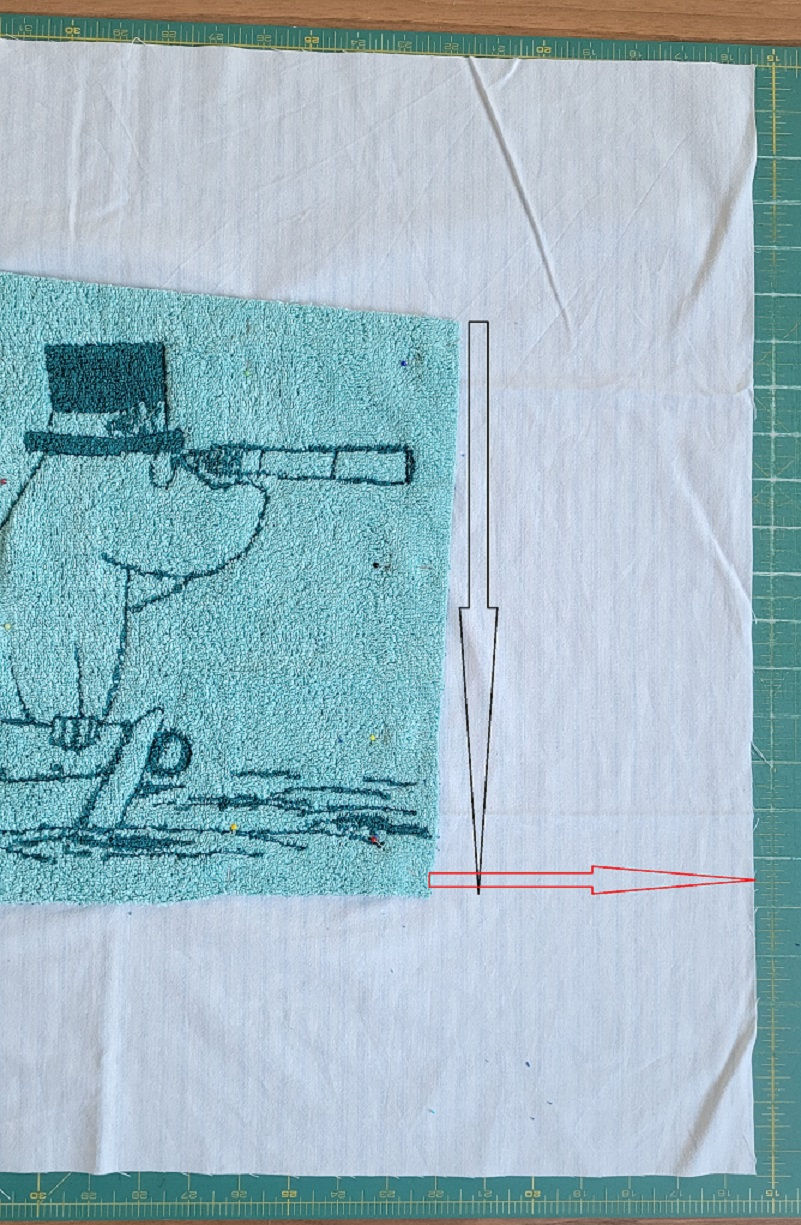
How to measure the size of the second piece In my case, the right edge of the Moomin piece measured 12 inches (30.5 cm), and the distance to the edge of the base was 6¾ inches (17 cm). I cut the second piece 12 inches (30.5 cm) long and 7½ inches (19 cm) wide, allowing extra width to compensate for the seam allowance and the fact that the right edge of the first piece wasn’t straight but slightly diagonal.
Once you’ve determined the measurements, cut the second piece to size. Place it on top of the first piece along the right edge, align the edges, and sew along the edge using a 3/8" (1 cm) SA. Make sure to secure the beginning and end of your stitching.

Attaching the second piece Flip the second piece onto the base fabric, press the seam with steam. Quilt several lines across the second piece, parallel to the seam. Travel along the edge from the end of one line to the beginning of the next. You can quilt straight, asymmetrical, or wavy lines, and they don’t need to be very close together. With towels, the quilted texture or lines aren’t very visible on a thin cotton base - the quilting is mainly done to stabilize the pieces on the base.
For quilting, keep the needle in the down position and use a stitch length of 2.5 to ensure even, controlled stitches.
Measure, Cut, Place and Quilt the Third Piece
The same way we measured before, measure the combined length of the first two pieces along the bottom (shown by the black arrow in the photo below) and the distance from the bottom edge of these pieces to the bottom of the base fabric (shown by the red arrow).

How to measure the size of the third piece Cut the third piece to fit, then attach it to the bottom of the first two pieces just like we did with the second piece, press and quilt it in place.
For this piece, I chose wavy lines as the quilting design, but you can stick with straight or asymmetrical lines if you prefer.

Quilting wavy lines Make, Place and Quilt the Fourth Piece
The fourth piece is quite large, so we’ll build it from several smaller pieces. First, lay out the pieces to make sure the arrangement is balanced and visually pleasing. If you have a piece that is large enough, you can of course use a single piece instead.
Please note that I intentionally don’t give exact measurements for these pieces. Rather than following precise dimensions, this step is meant to show how I pieced my panel. I encourage you to use the pieces you have on hand and treat this as an opportunity to practice creative, intuitive piecing.
Tip: Take a photo of the layout before sewing – it will help you remember the placement of the pieces and make joining them together easier.
The numbers in the photo below indicate the order in which I stitched the pieces: Stitch the pieces into one long panel, then attach and quilt the panel in the same way as the previous pieces.

Piecing order Join two pieces together and press the seam open using steam to help the fabric lay flat. Continue adding pieces until you have a panel large enough to cover the space to the left of the first and third pieces sewn onto base.
Tip: The towel fabric might stretch, so I recommend trimming the edges after sewing the
pieces together and pressing to ensure everything stays neat and aligned.

Once the panel is assembled, place it wrong side (WS) up along the left edge of the quilted first and third pieces and stitch along the edge. Then, flip it right side (RS) up on the base, press the seam. Pin the panel in place, and quilt it just like the previous pieces.
Make, Place and Quilt the Fifth Piece
Build the last piece in the same way as the fourth piece - this will be one long piece. Use the leftover bits from the towels you have already cut.
First, lay out the pieces to make sure the arrangement is balanced and visually pleasing.


Trimming the Rug Panel
Using a ruler and a rotary cutter, square the rug panel to 33½ × 21½ inches (85 × 55 cm) or the size you need, trimming away any excess fabric along the edges. For rounded corners, place a plate on each corner and use it as a template to trim smooth, even curves.

Rounding the corners 
The squared top with rounded corners 
Testing the quality 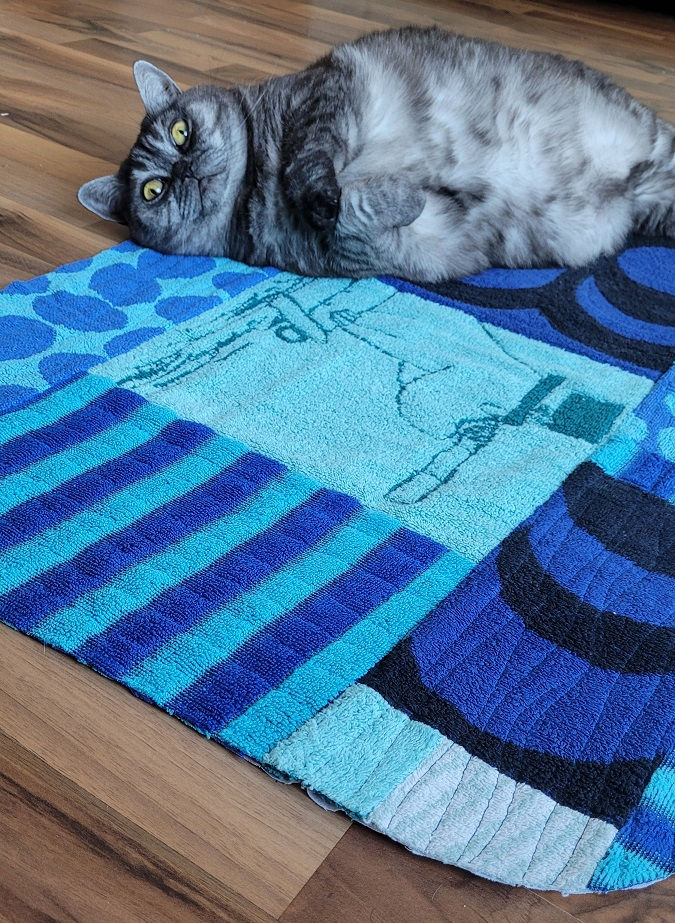
Approved! If desired, you can add a label for a personal or decorative touch.
8. Adding the Back and Finishing
For my rug, I used an old IKEA pillowcase as the backing. I cut it open along one seam and didn’t square it up to a specific size - I just made sure it was larger than the quilted top.

Adding the backing fabric Place the backing right side (RS) up on the table, then place the quilted top wrong side (WS) up on top, so the right sides of the backing and top are together. Pin the layers securely and stitch around the rug 3/8" (1 cm) from the raw edge of the top, leaving an opening of about 5 inches (12–13 cm) for turning. Secure the beginning and end of your stitching, and stitch slowly with the needle in the down position to create smooth line.

Stitching around the edge of the rug Trim the seam allowance (SA) using pinking shears to slightly less than 3/8" (1 cm) to reduce bulk and create smooth, rounded corners.

Trimming the seam allowances Turn the rug right side out through the opening. Place your hand inside the rug and run your fingers along the corner seams to smooth them, then press the edges flat. Close the opening by hand-stitching for a neat finish.

Stitching the opening closed If desired, stitch around the edge of the rug, sewing approximately 1/4" (6 mm) from the edge to secure the layers.
The rug is ready!
I’m very happy with the result and especially satisfied to have made something from old towels that will be used every day. If you decide to make your own rug using this tutorial and share it on Instagram, please tag me @nordiccrafter and @pfaff_suomi so we can admire your work!
Happy Sewing!❤


Comments