


Galla Grotto: Eyes Are the Mirror of the Soul
Today, I present Galla Grotto, one of the most prominent textile artists of our time. I have known her since 2022, when she came to my solo exhibition at the Carrefour Quilt Show in France. For me, exhibiting abroad for the first time, meeting such a renowned master was both a great honour, yet also rather intimidating. But Galla’s kindness and openness quickly laid any butterflies in my stomach to rest. Today, I remember that meeting with a smile, and since that first encounter my admiration for her work has only deepened.
She is best known for her powerful portraits of women, whose eyes seem to look straight into your soul. Her quilts echo the presence of Byzantine icons while remaining unmistakably contemporary. Instantly recognisable, she is truly an Artist with a capital “A.”
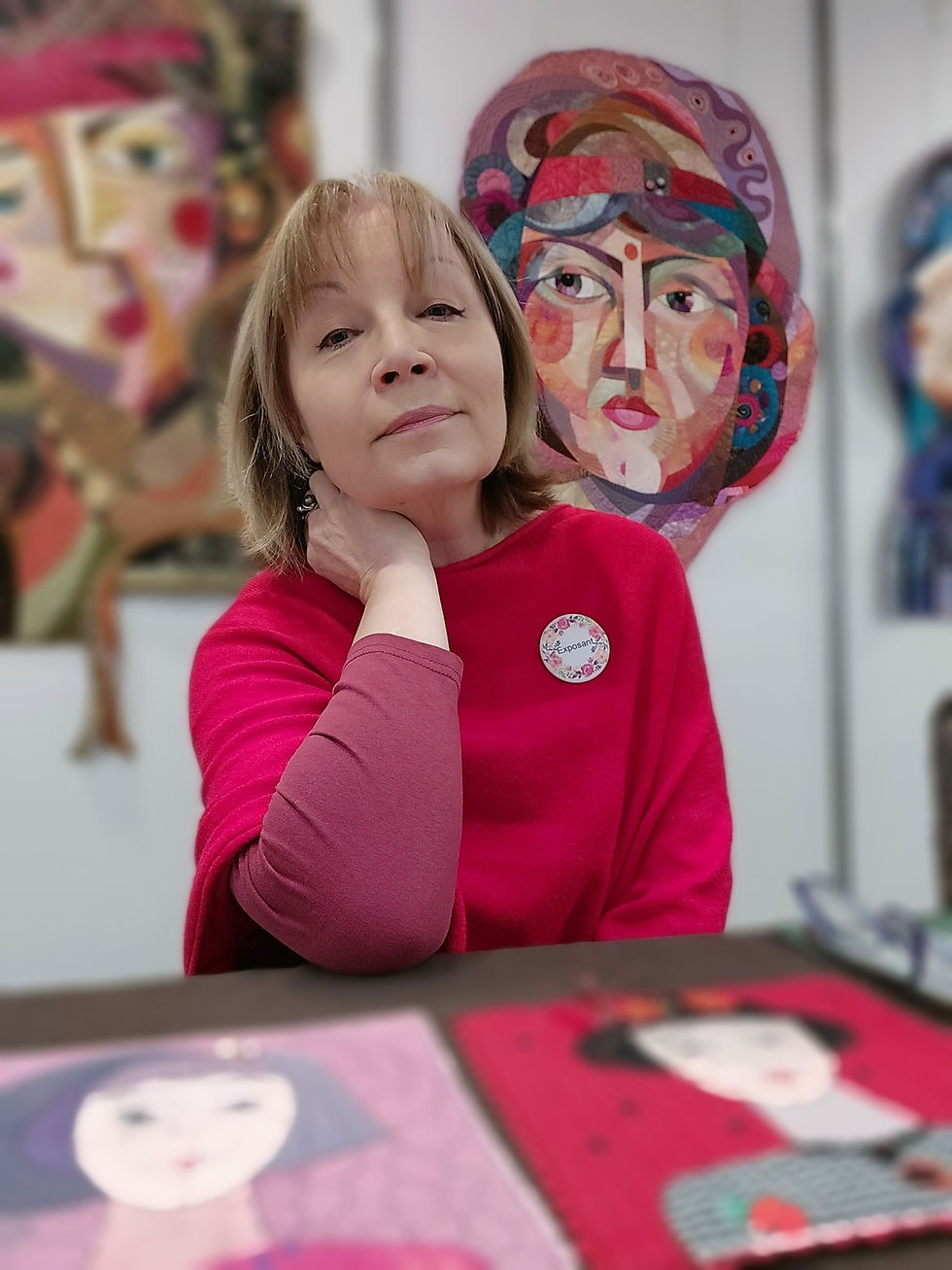
We share a common language, and our conversations about art, life, and the stories behind her quilts can last for hours without ever running dry. With over 250 exhibitions, more than 100 invitations to exhibit, and over 50 awards, Galla’s career speaks for itself. Now, it’s time to read and enjoy her story.
Before patchwork became part of your practice, you had a rich artistic journey. How did your background and experiences lead you to textile art?
I didn’t grow up in an artistic family, my parents were workers. I discovered drawing almost by accident at fourteen, when I found an old sketchbook at home and started filling the empty pages. A neighbour saw my drawings and encouraged me to study art. I enrolled at an art school that had just opened in Tver, Russia, graduating in interior design.
For my diploma, I wanted to do something different than painting to stand out of the crowd. At home we had many fabric scraps because my mother occasionally sewed clothes. As a child, I used to play with fabric rather than dolls, so working with textiles felt very natural. For my diploma, I created a series of textile collages for a kindergarten and received the highest grade. Soon after graduation I moved to Ukraine. However, because textile art wasn’t really considered “art” in the USSR, so I continued mainly painting, returning to fabric only from time to time.
In 1993, I received a book of ancient Eastern romance texts. I visualise very strongly when I read, and felt the need to express those visualisations in a way that a painting couldn’t capture. I locked myself in my apartment for a month and started creating large textile pieces on my old sewing machine that had only 2 stitches (straight and zigzag). I didn’t even know what patchwork or quilting was, I was simply sewing reclaimed fabrics together with a zigzag stitch. I stretched them on frames like canvases.

That is how I created the series Red Light District – Love District. Although I’m quite modest in life, I’m not in my art. I took the photos of the works to Moscow and proposed an exhibition at the Central House of Artists. At that time, artists often waited years to exhibit, but in my case, it happened surprisingly quickly and became a turning point in my career. I exhibited both paintings and textile works. I was invited to tour the exhibition internationally for a year, but I couldn’t accept the invitation because my daughter was very young at the time. However, I did go to France, exhibiting first in Versailles and then in Lyon, and later showed this exhibition abroad many times.

After moving to France in 2006, I actively sought new opportunities. My paintings quickly gained attention and received numerous awards. Soon after, I discovered the Quilt Expo en Beaujolais, a textile festival near Lyon, and in 2010 I participated there for the first time with my textile work, which received the Grand Prix.

From that moment on, textile art became central to my practice. I met wonderful artists, and the richness of their ideas, techniques, and styles completely captivated me. Since then, I have participated in almost all major textile shows in France and internationally, and I have also taught workshops.
You are of Slavic origin but have lived in France for over 20 years. How have these cultures shaped you as an artist?
I love traveling, discovering other cultures and art. These experiences have enriched my perspective. I was born in Russia, lived for many years in Ukraine, and now live in France. These cultures intertwined in my work and helped me find my own artistic voice. I draw inspiration from the mythologies of different countries, and the characters in my textile art are mainly heroes from ancient myths.
When I moved to France, I understood that I needed to change. At that time, abstract art prevailed in the most prestigious French art salons, while portraiture was entirely absent. I saw that as an opportunity. I applied to the Lyon Winter Salon and was accepted on my first try.

Back in Ukraine, I had painted many official portraits of political and ideological figures. Some of them I could even paint with my eyes closed! Therefore, portraiture was very familiar to me. For Lyon, I created a series of black-and-white portraits of famous figures such as Édith Piaf, Karl Lagerfeld, Salvador Dalí etc. My goal was not simply to depict them, but to let their love stories speak through the portraits. I used a collage technique based on newspaper articles, their own quotes, and immersed myself in their lives watching films, listening to music, and studying their life stories. The series was a great success.
I truly believe that the more cultures you experience, the richer you become as a person. My work today is shaped both by my Slavic roots and by who I became in France, after allowing myself to change and evolve.

What makes you different from others? Is there anything that people often misunderstand about you?
It is important for an artist to be honest and to speak about what they truly know and feel. Invented stories often feel false, and the audience senses that. Finding one’s own style and artistic voice unfolds differently for everyone. Some people are lucky and discover their style easily, regardless of whether they have a professional artistic background. But artistic education can sometimes become an obstacle: you are trained to follow rules, imitate others, and meet expectations rather than to be yourself. At some point, you have to unlearn that, look inward, and find your own voice. Some say that to be different you shouldn’t look at what others create, but I strongly disagree. You need to see others’ work in order to truly become different, without copying it.
In my case, my professional artistic background helps me realise any idea technically, and that allows me to focus fully on expressing my own vision. Everyone understands art differently - some see more, some less - but I hope my work never leaves people indifferent.


When we interact with other people, we look into their eyes. That often tells us more than words. My characters cannot speak, but they engage with the audience through their eyes, conveying thoughts and emotions. Even for me, it is often surprising how much emotion tiny pieces of fabric measuring just 1.5 cm can express, how the characters feel alive, able to grieve, rejoice, love, or even judge.

It is very important to doubt yourself, especially at the beginning. Doubt becomes motivation that pushes you to search for new ideas and forms, and to perfect the technique and quality. I love my works because they are a part of me at different periods of my life - my sincerity, my desires, and sometimes my pain. But if there’s something in my project I’m not satisfied with, I keep working on that piece until I love every millimetre of it.
What is your favourite part of the quilt making process?
I don’t really have a favourite part. I truly love and enjoy the entire process. Once I have an idea and a clear image in my head, my hands almost shake with anticipation when I start drawing the design. I feel happy when I find the right colours and when I begin sewing the pieces together. Even during the quilting stage, I can work for seven or eight hours. While I may feel physically tired, I still want to continue, just to see how the next area will look.
What inspires your projects?
I have so many ideas that I’m sometimes afraid I won’t have enough time to realise them all. Making a quilt takes time, and with each new piece I feel the need to do better than before. While I’m still working on one quilt, another idea is often already forming in my mind.
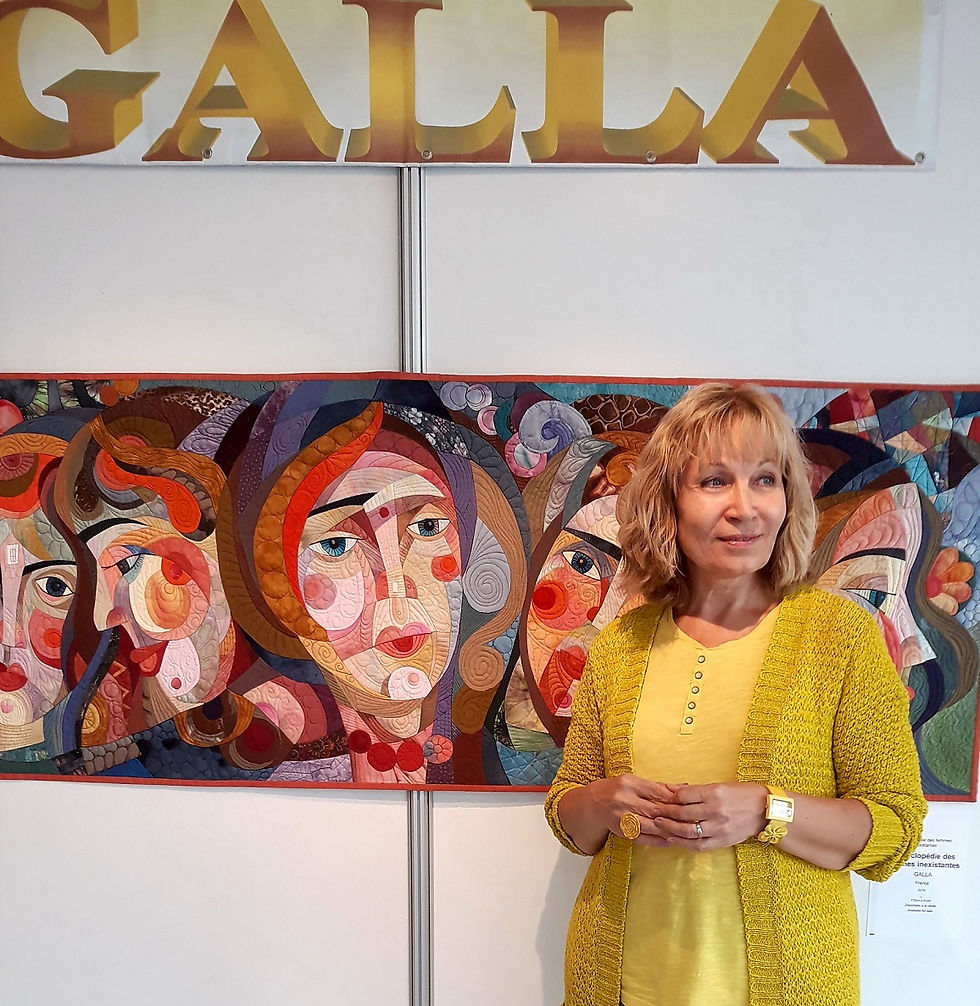
That’s one of the reasons I work in series. Earlier, my quilts focused mainly on composition; they were good works, but they didn’t fully define me as an artist. Everything changed in 2017 when I began the Women Encyclopedia series. It was noticed immediately, and I became strongly identified with those portraits of women. It felt like it was the right theme for the right moment. My style, my ideas, and that subject hadn’t really been explored that way before. There was a balance between concept, craftsmanship, and identity. It felt as if the stars aligned.
What defines a successful quilt for you? A design, colour, technique, emotional impact or balance between all these?
For me, balance is the most important factor. A successful quilt is not defined by just one element but by how all of them work together. I believe the idea carries about 80 % of the success, while execution makes up the remaining 20 %. Without a strong idea, even perfect technique feels empty, but when the concept is right, everything else finds its place.
What is your favourite work? Why?
For many artists, their most recent work is often their favourite. It’s almost as if you are still deeply connected to it, as if by an umbilical cord. That connection fades with earlier works. Still, every artist has one piece that feels truly important, a work that marks an evolution in their practice. For me, that work is Mother Earth (2016).

It felt as if I had been carrying it inside me for nine months. I knew I had to make something, even before I fully understood what it was. I would wake up in the middle of the night with the image of the character in my mind. When I was finally ready to draw the design, it came effortlessly and I completed it in fifteen minutes without using an eraser even once. It felt urgent, as if time was running out. My head was so full of thoughts that I began writing them down.
When the quilt was finished, I hung it on the wall, sat down in front of it, and felt as if I were lost in her eyes. I brought Mother Earth to a quilt festival in Canada. I couldn’t attend the award ceremony, but the next day I learned that the work had won a ribbon and had been sold. Letting it go was difficult.
The following day, when only visitors were present, there was always a big crowd around the quilt. Women cried when they stood in front of it; they felt the sadness in Mother Earth’s eyes. That was the moment I understood why I had needed to make this work - it was meant to exist. I have tried to achieve the same emotional impact in later works, but none of them have yet compared with Mother Earth.
For those who are just discovering the patchwork, what advice would you give?
First of all, I envy them as they have so much to discover. Today there are books, online resources and exhibitions, with textile art itself being far more developed than when I began. My advice would be to stay curious: look at as much textile art as possible and analyze the works that truly resonate with you.
The search for a personal style will come later. In the beginning, it is more important to build ideas and master technique. You need to work hard on learning and perfecting your skills. Not everyone can easily master design, but belief, vision, and persistence are essential.
All images featured in this post are courtesy of Galla Grotto.


Comments