


Vuokko Isaksson: 60 years in Modern Quilting
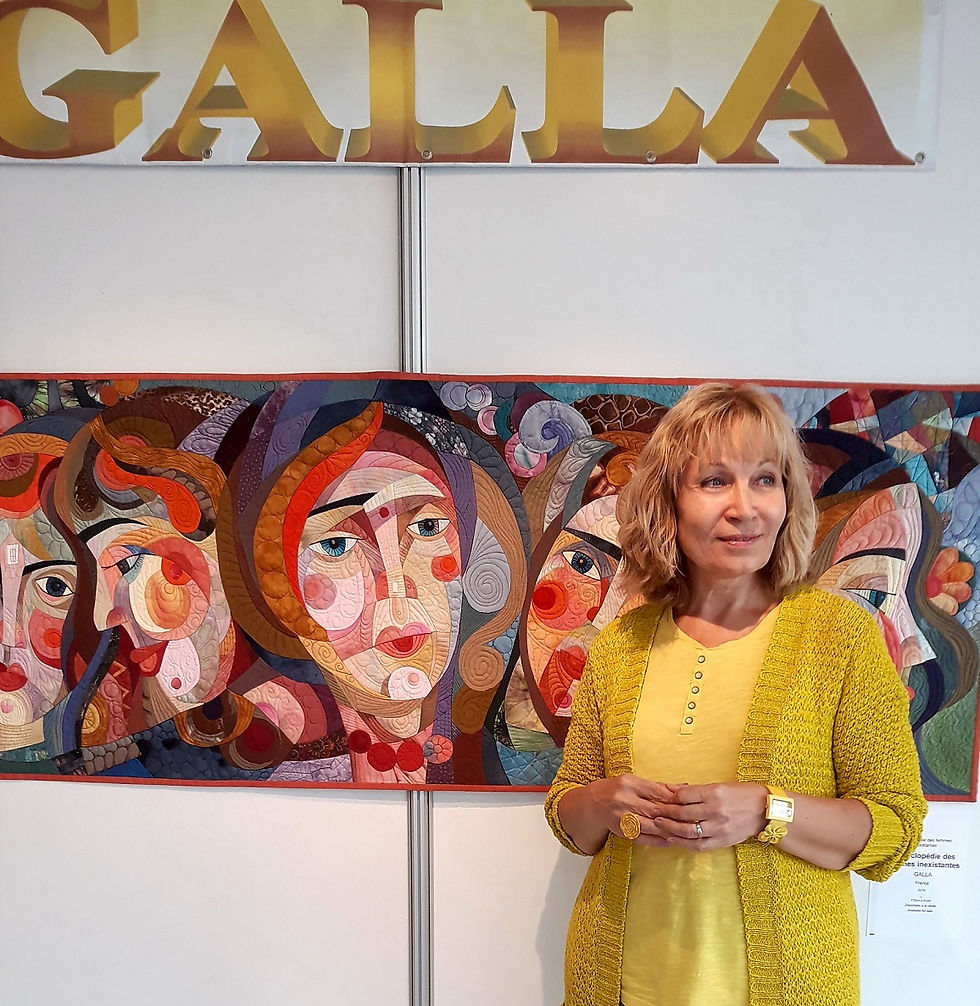
Today, I am proud to present Vuokko Isaksson (b. 1945), a legend of Finnish modern quilting. I have known of her since I joined the Finn Quilt Association in 2017 and began reading her interesting articles in Finnish Patchwork Magazine. However, I only met Vuokko in person last autumn, in 2025, at the Carrefour Quilt Show in France. While I admire her quilts, what I admire most is her strong, rebellious spirit. She is not the kind of person one would describe as “an old woman”.

Vuokko Isaksson graduated as a handicraft teacher in 1968. She, like all other Finnish handicraft teachers at the time, was taught to simply have students copy teachers' examples. Vuokko however decided to go a different route. In her teaching she applied a maker-centered approach, concurrent to that taken by the American new wave patchwork feminists in the late 1960s.
This radical approach was not received well by the public, other teachers and the members of the board of the Keminmaa Adult Education Centre where she worked in early 1970s. Some local women were outright forbidden from attending her course, since she didn’t follow traditional instructions. The management of the Adult Education Center ended up firing Isaksson for her radical views on handicrafts education. Yet no matter what life brought her, she continued to teach and create.

Isaksson was not only rebellious in her teaching, she was also rebellious in her artistry. She started making modern quilts in the late 60s, when people were not ready to accept nor even understand that quilts can be a powerful means for self-expression, rather than just utilitarian objects.

Vuokko Isaksson has held over 40 solo exhibitions and participated in more than 70 group exhibitions. Her positions have ranged from artist organizations and women's associations to membership in the Central Arts Committee and chairmanship of the National Board of Crafts.
What makes her journey even more remarkable is that, in 2024 at the age of 79, she completed a PhD! Her dissertation “The Rise of Quilt from Bed to Wall: The Transformation of Everyday Textiles into a Means of Visual Expression in Finland in 1945–2015” is the first piece of research in that field. This extensive 626-page study examines the evolution of quilting within Finnish gendered handicraft culture, focusing on quilters themselves, their working environments, techniques, and methods, as well as the histories and motivations that have driven them to pursue quilting as a form of self-expression across decades.
I read the dissertation with great interest and thoroughly enjoyed discovering Finnish quilting history, including many names and quilts that were previously unknown to me, yet far ahead of their time.
Looking ahead, in January 2027, the Finnish Craft Museum in Jyväskylä will present an exhibition featuring twenty three works drawn from her doctoral research. In addition, Vuokko Isaksson will have a personal exhibition in the museum celebrating sixty years of her quilting journey, a milestone that reflects both her lifelong dedication and her continuing influence on Finnish contemporary textile art.
1. When and how did you start quilting?
I was 14 years old when my friend received a quilt made from old neckties as a Christmas gift from her aunt. I was instantly fascinated and wanted one for myself. My mother told me there was an old quilt stored away in the attic and suggested that I could cover it myself. So I did. I cut square-shaped pieces of fabric and sewed them together, then went out and bought red cotton for the backing. I ended up using the entire old quilt.
I sewed my first artwork in 1970, at the age of 25. It was a modern interpretation of a traditional folk motif, Hannu’s Coat of Arms, appliquéd onto plum-colored silk velvet. My father painted the background in gold. At the time, I didn’t yet think in terms of quilt textiles.
In 1973, I held my first exhibition at the Kemi Art Museum, followed by exhibitions in 1976 both in Kemi and Kajaani.

2. What does quilting mean to you personally?
For me, quilting above all means making art. The content is built not only on ideas, but also through a creative use of handicraft techniques and materials as an essential part of the expression.
I am a feminist, and it has always been important to me to elevate women’s millennia-old craft culture and place it alongside other visual arts, not as something secondary, but as an equal and powerful form of artistic expression.

3. What are your favorite quilting techniques, and why?
Techniques and working methods are, for me, tools for expressing the content of a quilt rather than primary approaches in themselves. Because I received professional training as a craft teacher, mastering techniques and applying them creatively has always been a natural part of my artistic expression.
The content of each piece determines which working methods I use. I see this versatility not as a limitation, but as a form of wealth.
4. Finnish textile art is often described as modern, and not strongly influenced by American quilting traditions. Do you agree with this view? Why or why not? What do you think most strongly shapes the Finnish approach?
Finnish textile and quilt art has certainly developed its own original and modern character, but it has not emerged in isolation from international influences, particularly from the United States.
Many of the founders of the so-called Modern Art Quilt Movement in the United States were feminists. They consciously viewed the quilt tradition as women’s art and used it as a means of contemporary artistic expression. This same feminist motivation was also present in Finland when the Finn Quilt Association was founded in 1990.
Several of the founding members had attended quilt festivals in the United States and witnessed how quilting had, as it was often said, “moved from the bed to the wall.” Bringing quilts into galleries and museums felt like a natural step, and in Finland the association began its activities very actively, organizing public exhibitions. This exhibition-oriented approach strongly guided members toward contemporary quilt art rather than traditional utility quilting.
In 1994, the Design Museum organized a large exhibition called “Patches, Patches” with accompanying activities. In 1996, I was invited to curate the exhibition "Happiness from Patches" at the Kemi Art Museum, where I presented the works of six Finnish contemporary quilt artists.
At the same time, Finland has its own long patchwork tradition. The oldest preserved Finnish patchwork quilt, dating from 1795, is in the Lahti City Museum.
5. The early 1990s were a very difficult period economically in Finland, yet Finn Quilt Association was founded in 1990, and Finnish quilts gained significant international recognition soon after. Why do you think so many strong and successful works emerged during such a challenging time?
The early 1990s were indeed a difficult time economically and socially in Finland, but many members of Finn Quilt were teachers in the craft field or worked in other professions that were not directly affected by the economic depression. This gave us a certain stability and allowed us to continue working creatively despite the situation.
We regularly received information about international developments and events in quilting, and we all spoke English, which made it easier to connect beyond Finland. Perhaps most importantly, we had enough courage to venture out into the international arena without hesitation.
In the early years, we were not interested in commercial patchwork fabrics at all. Instead, we worked with recycled materials, dyed fabrics ourselves, and used what we already had in our stashes. The storage rooms of craft professionals were full of interesting materials, and this encouraged experimentation.
I believe this combination of professional confidence, international openness, material resourcefulness, and a strong shared motivation helped produce such powerful and successful work during a time that was otherwise marked by uncertainty.
6. What are your three favorite quilts, and why?
In 1993, I participated in an improvisation workshop led by the world-renowned quilter Nancy Crow in Brussels. Improvisation immediately became central to my work. I had grown tired of overly straight lines and meticulous precision, and improvisation offered a new sense of freedom and expression. My quilt Spring in Brussels started during that workshop. The city of Oulu later purchased the piece and presented it as a gift to Finland’s first female president, Tarja Halonen.

Another important work for me is When I will see the blue of the sky. In 1997, the Max Berk Textile Museum invited 100 internationally recognized quilt artists to submit work for the juried exhibition Quilt Art: From Baroque to Avant Garde. Fifty-two artists responded, and only 25 quilts were selected. My quilt was among those chosen. In January 2026, when the exhibition 9th Quilt Art Triennale 2025 was shown in Tampere, Finland by the Heidelberg Museum, I had the pleasure of donating this quilt to the museum’s permanent collection.

The third quilt is Princess D. I discovered organza during a trip to Canada in 2001 and ended up buying an entire suitcase full of it. This piece is sewn entirely from organza, sequins, and buttons. It received its name while I was sewing on the sequins and watching a television documentary about the life of Princess Diana. Organza has remained an important material for me, and I continue to use it extensively in my art quilts.

7. When you start a new quilt, do you usually work from a clear plan, a partial plan, or do you design intuitively as you go?
I am very much an improvisational quilter. A new project can begin from something very small: a tiny scrap of fabric, a photograph, or simply an idea. I rarely start with a fixed plan; instead, the work evolves as I respond to the materials and what they suggest to me.
Recently, I have been reflecting on my large collection of experimental scraps. For a moment, I even wondered whether I should throw them away. As I prepared for a new exhibition, however, I had a sudden realization: a seed is a beginning for something new. Those experimental scraps are exactly those seeds. They hold potential and memory, waiting to grow into new quilts.


This way of working is not new to me. In the 1990s, I created an exhibition inspired by the dance music of my youth. Each quilt depicted something personally meaningful drawn from the popular music of that time. In that sense, improvisation has always guided my practice allowing personal history, material intuition, and chance to shape the final form.
8. In your opinion, what is most important for the success of a quilt: design, colour, technique, emotional impact, message - or the balance between them? Why?
For me, the success of a quilt depends on balance between design, colour, technique, emotional impact, and message. None of these elements exists in isolation. The most important thing is the content: everything else exists to serve what the work wants to express.

Because I work through improvisation, these choices are not fully decided in advance. They emerge gradually as the quilt progresses. I often describe this process as climbing a lookout tower. At the beginning, there is only a door - perhaps just two patches sewn together. As you go, with every step, the view expands: I gain more insight into the material, the form, the working methods, and the developing composition. Only at the very top of the tower do I finally see the landscape - the quilt as a whole.
9. What advice would you give to someone who is just at the beginning of their quilting journey?
Since 1970, I have been developing a pedagogy for creative making and teaching. One third of our brain is connected to our hands, so I never teach by asking students to copy a ready-made model. Each of us has our own unique handprint as well as the right to think for ourselves. A teacher has no right to decide how a student or course participant should think. This applies equally to children and adults.
The task of a teacher is to open doors to possibilities. The wheel does not always need to be reinvented, but everyone must be allowed to choose their own direction. For someone just beginning their quilting journey, my advice is to trust your hands, your curiosity, and your own way of thinking.
I am currently writing a book about this approach and about my experiences with the maker-centered pedagogy I have developed. I feel this work is urgent so that artificial intelligence does not take away our right to use our hands and brains as the source and realization of our own creativity.
As the film director Jean Renoir once said, every handmade object brings greetings from its maker.
All images courtesy of V. Isaksson.
I thoroughly enjoyed putting this interview together, as it is full of wisdom and inspiration, just like Vuokko Isaksson herself. I hope it offered you something new, or perhaps a small shift in how you see your own creative process.
I’d love to hear from you in the comments: did any part of her journey resonate with you or spark a new idea?


I loved reading of her approach to design amd quilt making. It is very inspiring.
Thank you for sharing this. I really enjoyed it. ❤️
Deborah Meyer